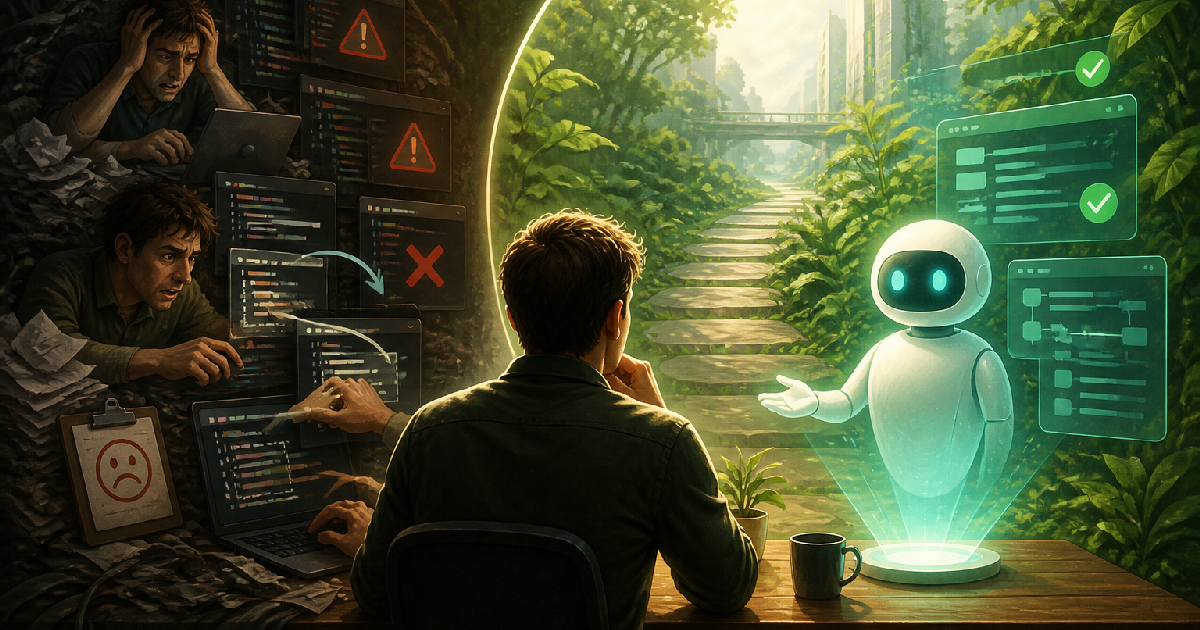

Most of us treat software as a series of destination points. When we need to solve a problem, we go to a website, open an app, and navigate through a structured set of screens that a designer built months or years ago. But on July 30, 2026, a mundane task—planning a grocery trip—showed me that our relationship with user interfaces is fundamentally ready for an upgrade. The screen is no longer a static cage. It is becoming a live, rendered outcome of the current moment.
The Grocery Trip That Became a Case Study
I was in the middle of a standard conversation with ChatGPT. I was planning a trip to Walmart and wanted to make sure I was not wasting money on items I already had in the pantry. Through natural conversation, the assistant and I inventoried my house. It learned that I already had chicken breasts, six eggs, rice, and oats. It then cross-indexed that against my dietary preferences to build a specific list: bananas, frozen blueberries, milk, vanilla Greek yogurt, mixed vegetables, penne, Alfredo sauce, Parmesan garlic sauce, tortillas, mozzarella, sugar-free drink packets, and butterscotch pudding.
Every time the AI suggested something I did not need or like, such as more oats or chocolate pudding, I just mentioned it. The AI updated the list in real time. But the real friction point hit when I asked for a checklist I could tap while walking through the store. A text-based list is difficult to manage on a phone screen while pushing a cart. The AI initially offered to generate a standalone HTML document.
That is where I stopped it. I did not want an arbitrary piece of code that could break or look disjointed. Instead, I asked the agent to render the list through JuanPager. Within seconds, I had a functional, interactive checklist on my phone.
Beyond Arbitrary Code
The beauty of this interaction was not in the design of the checklist itself. It was in the fact that the interface was not pre-baked. JuanPager is a serverless runtime for shareable human surfaces. Instead of asking an AI to write HTML, CSS, and JavaScript—which is messy, insecure, and prone to breaking—the agent simply emitted a small, structured JSON object: a moment.
This moment contained the items, categories, and allowed affordances. My local browser acted as the trusted runtime. It validated that data and composed the interface on my device. Crucially, the state of my checklist—the items I checked off as I moved through the aisles and the adjustments I made to quantities—persisted locally. I did not need a backend database or a cloud account to track my progress. The URL fragment carried the state of the moment. This is a massive shift in how we think about building software.
UI as a Runtime Concern
My theory is that the fixed, manually designed screen is becoming less important. We are moving toward a world where we stop prebuilding a screen for every possible workflow. Instead, the process looks like this: an agent understands the intent, produces a structured description of the immediate task, and a trusted runtime synthesizes the useful interface on the fly.
Consider the difference between traditional development and this approach:
- Old Way: A designer builds a screen. A developer codes the screen. A user finds the screen and tries to force their intent into the limited options provided.
- New Way: A user expresses an intent. An agent gathers constraints. An interface is composed at runtime specifically to fulfill that exact moment.
This is not a death knell for design. It is a new canvas for design. Designers will spend less time drawing pixel-perfect rectangles for every edge case and more time building robust, trusted component libraries that can handle any valid moment the agent throws at them. The durable layer is not the screen. The durable layer is the protocol, the data, the permitted actions, and the rendering runtime.
Why Structured Moments Beat Mini-Websites
If you ask an AI to write a web page, you are asking for technical debt. The generated code is usually fragile, unoptimized, and potentially dangerous if it includes malicious scripts. By enforcing a strict schema, a tool like JuanPager creates a security boundary. The AI only provides the content and the data. The runtime provides the functionality. Because the agent does not own the design, the interface stays consistent, accessible, and high-quality every time.
This approach moves the complexity from the frontend developers to the data structures. When the underlying component library is updated, every past link—including my grocery checklist—becomes more performant or accessible without ever changing the source of the interaction. You are essentially decoupling the presentation from the intent.
The Future of Operational Software
While this sounds abstract, the application for business software is enormous. Think about the tools we use daily at FlowDevs:
- RMM Systems: Instead of opening a dashboard to hunt for a server error, an agent could synthesize a remediation surface. You get a single view with exactly the status data and the reboot or patch buttons relevant to that specific alert.
- CRM Systems: A ticket comes in. Instead of navigating through dozens of tabs, an agent presents a review-and-send surface, prepopulated with the customer history and candidate responses, allowing you to act immediately.
- Purchasing: A conversation about vendor options can turn into a live comparison table where you can flag constraints or approve drafts directly from the chat.
Where the Theory Hits Limits
We are not at a point where we can replace all interfaces. There are clear risks and limitations to consider. High-stakes actions, such as financial ledger movements or medical diagnostic tools, still require strict, deliberate design guardrails. You cannot generate a user interface for every context; some workflows are too complex or demand too much consistent cognitive mapping to leave to runtime synthesis.
Accessibility is another massive hurdle. If an interface is generated on the fly, it must be inherently accessible. Trust is also a factor. We need to be able to verify that the runtime is not being manipulated and that the agent is not tricking a user into an action they did not intend. While these problems are solvable, they are not currently solved. This is an early proof of a theory, not a universal standard.
The Next Step
The future is not a world without interfaces. We will always need to see and manipulate data. But the future is a world without permanently fixed interfaces for every potential moment. As we continue to integrate AI into business strategy, we need to focus on these runtime protocols.
You can view the grocery checklist I generated here. You can inspect the project and the reasoning behind the runtime approach on our GitHub repository. The future of software is not fixed. It is as fluid as the conversations we have with our machines.
Frequently Asked Questions
Is this the same as just telling an AI to write a web app?
No. Telling an AI to write arbitrary code is unpredictable and dangerous. JuanPager uses a fixed schema and a pre-built internal runtime, meaning the AI simply fills in data, while the secure, local code handles the interaction and display.
Does the checklist require a database or server?
No. By passing the state through the URL fragment, the app requires no backend infrastructure. Everything is calculated and managed locally in your browser.
Can this be used for complex enterprise workflows?
At this stage, it is an early proof of concept. While it works well for simple structured tasks, we are still exploring how to apply it to complex legacy software environments and high-security enterprise requirements.
Are you suggesting we get rid of designers?
Quite the opposite. We need designers more than ever to create the component libraries and interface rules that these runtimes will use. The focus shifts from screen creation to systems design.
Was this used to order groceries at Walmart?
No. The checklist was a planning surface for a physical trip. All prices mentioned were estimates, and no actual financial transactions or inventory access took place through the tool.
Visit our bookings page if you want to explore how intelligent automation and custom runtime strategies can streamline your specific workflows.
Most of us treat software as a series of destination points. When we need to solve a problem, we go to a website, open an app, and navigate through a structured set of screens that a designer built months or years ago. But on July 30, 2026, a mundane task—planning a grocery trip—showed me that our relationship with user interfaces is fundamentally ready for an upgrade. The screen is no longer a static cage. It is becoming a live, rendered outcome of the current moment.
The Grocery Trip That Became a Case Study
I was in the middle of a standard conversation with ChatGPT. I was planning a trip to Walmart and wanted to make sure I was not wasting money on items I already had in the pantry. Through natural conversation, the assistant and I inventoried my house. It learned that I already had chicken breasts, six eggs, rice, and oats. It then cross-indexed that against my dietary preferences to build a specific list: bananas, frozen blueberries, milk, vanilla Greek yogurt, mixed vegetables, penne, Alfredo sauce, Parmesan garlic sauce, tortillas, mozzarella, sugar-free drink packets, and butterscotch pudding.
Every time the AI suggested something I did not need or like, such as more oats or chocolate pudding, I just mentioned it. The AI updated the list in real time. But the real friction point hit when I asked for a checklist I could tap while walking through the store. A text-based list is difficult to manage on a phone screen while pushing a cart. The AI initially offered to generate a standalone HTML document.
That is where I stopped it. I did not want an arbitrary piece of code that could break or look disjointed. Instead, I asked the agent to render the list through JuanPager. Within seconds, I had a functional, interactive checklist on my phone.
Beyond Arbitrary Code
The beauty of this interaction was not in the design of the checklist itself. It was in the fact that the interface was not pre-baked. JuanPager is a serverless runtime for shareable human surfaces. Instead of asking an AI to write HTML, CSS, and JavaScript—which is messy, insecure, and prone to breaking—the agent simply emitted a small, structured JSON object: a moment.
This moment contained the items, categories, and allowed affordances. My local browser acted as the trusted runtime. It validated that data and composed the interface on my device. Crucially, the state of my checklist—the items I checked off as I moved through the aisles and the adjustments I made to quantities—persisted locally. I did not need a backend database or a cloud account to track my progress. The URL fragment carried the state of the moment. This is a massive shift in how we think about building software.
UI as a Runtime Concern
My theory is that the fixed, manually designed screen is becoming less important. We are moving toward a world where we stop prebuilding a screen for every possible workflow. Instead, the process looks like this: an agent understands the intent, produces a structured description of the immediate task, and a trusted runtime synthesizes the useful interface on the fly.
Consider the difference between traditional development and this approach:
- Old Way: A designer builds a screen. A developer codes the screen. A user finds the screen and tries to force their intent into the limited options provided.
- New Way: A user expresses an intent. An agent gathers constraints. An interface is composed at runtime specifically to fulfill that exact moment.
This is not a death knell for design. It is a new canvas for design. Designers will spend less time drawing pixel-perfect rectangles for every edge case and more time building robust, trusted component libraries that can handle any valid moment the agent throws at them. The durable layer is not the screen. The durable layer is the protocol, the data, the permitted actions, and the rendering runtime.
Why Structured Moments Beat Mini-Websites
If you ask an AI to write a web page, you are asking for technical debt. The generated code is usually fragile, unoptimized, and potentially dangerous if it includes malicious scripts. By enforcing a strict schema, a tool like JuanPager creates a security boundary. The AI only provides the content and the data. The runtime provides the functionality. Because the agent does not own the design, the interface stays consistent, accessible, and high-quality every time.
This approach moves the complexity from the frontend developers to the data structures. When the underlying component library is updated, every past link—including my grocery checklist—becomes more performant or accessible without ever changing the source of the interaction. You are essentially decoupling the presentation from the intent.
The Future of Operational Software
While this sounds abstract, the application for business software is enormous. Think about the tools we use daily at FlowDevs:
- RMM Systems: Instead of opening a dashboard to hunt for a server error, an agent could synthesize a remediation surface. You get a single view with exactly the status data and the reboot or patch buttons relevant to that specific alert.
- CRM Systems: A ticket comes in. Instead of navigating through dozens of tabs, an agent presents a review-and-send surface, prepopulated with the customer history and candidate responses, allowing you to act immediately.
- Purchasing: A conversation about vendor options can turn into a live comparison table where you can flag constraints or approve drafts directly from the chat.
Where the Theory Hits Limits
We are not at a point where we can replace all interfaces. There are clear risks and limitations to consider. High-stakes actions, such as financial ledger movements or medical diagnostic tools, still require strict, deliberate design guardrails. You cannot generate a user interface for every context; some workflows are too complex or demand too much consistent cognitive mapping to leave to runtime synthesis.
Accessibility is another massive hurdle. If an interface is generated on the fly, it must be inherently accessible. Trust is also a factor. We need to be able to verify that the runtime is not being manipulated and that the agent is not tricking a user into an action they did not intend. While these problems are solvable, they are not currently solved. This is an early proof of a theory, not a universal standard.
The Next Step
The future is not a world without interfaces. We will always need to see and manipulate data. But the future is a world without permanently fixed interfaces for every potential moment. As we continue to integrate AI into business strategy, we need to focus on these runtime protocols.
You can view the grocery checklist I generated here. You can inspect the project and the reasoning behind the runtime approach on our GitHub repository. The future of software is not fixed. It is as fluid as the conversations we have with our machines.
Frequently Asked Questions
Is this the same as just telling an AI to write a web app?
No. Telling an AI to write arbitrary code is unpredictable and dangerous. JuanPager uses a fixed schema and a pre-built internal runtime, meaning the AI simply fills in data, while the secure, local code handles the interaction and display.
Does the checklist require a database or server?
No. By passing the state through the URL fragment, the app requires no backend infrastructure. Everything is calculated and managed locally in your browser.
Can this be used for complex enterprise workflows?
At this stage, it is an early proof of concept. While it works well for simple structured tasks, we are still exploring how to apply it to complex legacy software environments and high-security enterprise requirements.
Are you suggesting we get rid of designers?
Quite the opposite. We need designers more than ever to create the component libraries and interface rules that these runtimes will use. The focus shifts from screen creation to systems design.
Was this used to order groceries at Walmart?
No. The checklist was a planning surface for a physical trip. All prices mentioned were estimates, and no actual financial transactions or inventory access took place through the tool.
Visit our bookings page if you want to explore how intelligent automation and custom runtime strategies can streamline your specific workflows.