
Most AI coding demos end exactly where the real work begins: at a green unit test. Industry data shows that nearly 80 percent of deployment failures occur long after the tests pass, usually buried in environment misconfigurations and missing variables. You have probably felt this pain. The code works locally, but the live host returns a 404 error, the customer portal remains stuck on yesterday's image, and your build pipeline quietly skips a vital container app because someone forgot to set a configuration variable.
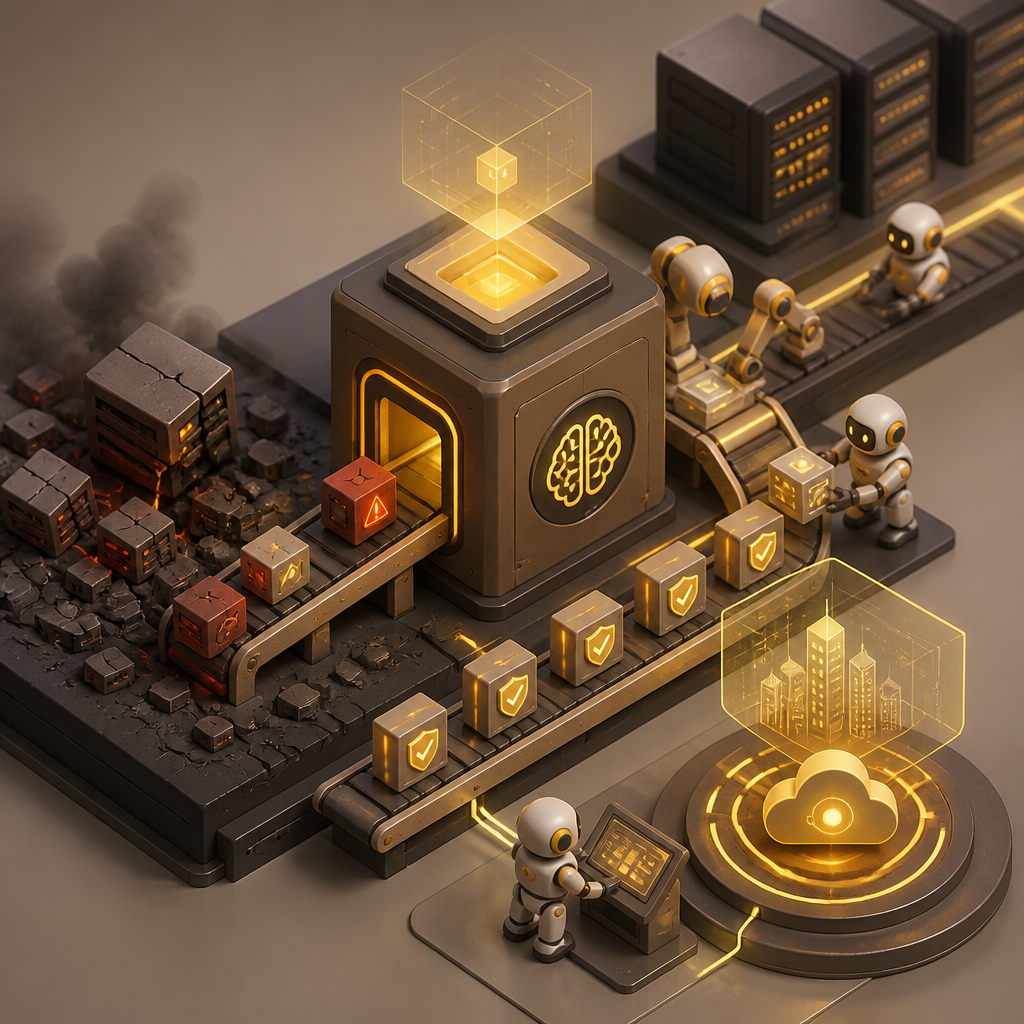
We recently tackled this exact friction using a method we call recursive shipping. It is an automated loop that treats deployment errors like a compiler warning, keeping your AI agent running until the only human step left is clicking a final approval button.
Why Local Testing Sets You Up to Fail
We were not building a feature in a vacuum. We needed to close a complex loop in an Azure Marketplace environment. The code had to automatically claim a software license without requiring hidden administrative tokens on the customer portal. The license host actually had to process the request. The customer portal needed to run a system image that verified this license before hitting the checkout page. Finally, the evidence had to land in our documentation so the next system wipe would not repeat the exact same errors.
This process is not a linear to-do list. It is a live feedback system. You hit friction, make the smallest possible code change, push a release, run a live test, and uncover the next piece of friction. Each turn shrinks the distance to full automation.
Keeping Three Azure Realities Coherent
If you want real automation, testing on your laptop is not enough. Research shows that over 60 percent of cloud downtime traces back to configuration drift, which happens when your test environment does not match reality. In one session, we had to keep three distinct Azure realities aligned simultaneously.
- The customer sandbox: This mirrors the Marketplace portal. If you ignore it, the billing system gets stuck on an authentication error.
- The publisher production portal: If this updates without a proper license validation check, it gives you false confidence in your deployment.
- The license host: If the validation route is missing here, every portal you just fixed is dead in the water.
Deploying locally from a script was completely out of bounds. The AI agent only had one honest path forward: an automated GitHub release with the production variables strictly set. That constraint forces the automation to match exactly how your customers will receive the software.
Three Code Changes, One Continuous Motion
The first code update landed the product path. We built the client logic, scrubbed out old scripts, and got the test harness green. When we pushed the release, we immediately noticed our variables for the license check were missing. Without them, the release updated the portal but entirely skipped the vital license container. Setting those variables was not a footnote (it was the core task of shipping). A live probe showed a 404 error, proving we needed to adjust the host.
The feedback loop talked back during the second pull request. A sandbox instance was stuck in a suspended state. This is exactly the kind of hidden trap that kills automated deployment cycles. The smallest fix was making sure the deployment secret could reactivate suspended rows. We shipped it and created a fresh instance ID.
The third code change wrote it all down. We updated our internal scorecards with the correct URLs, pass states, and the exact steps remaining for the human in the loop. Without recording this truth, the next AI agent or developer will just fall into the same trap tomorrow.
How Recursive Shipping Actually Works
Recursion here does not mean a complex computer science concept. It means self-similar closure. Every live failure produces a smaller, more focused change than the one before it. We fixed a suspended state, then set four variables, then updated one instance ID.
Every change is proven on the same surfaces that will actually fail your customers. Testing happens on the live license host and production URLs, not just in an isolated local terminal. You fold your evidence back into the same document the next run will read, so the loop compounds your knowledge instead of wasting your time.
The acceptance bar is never just merging the code. The bar is proving that an automated system can deploy the code, a portal can run it, checkout is unblocked, and a human only has to handle final policy consent.
Setting Guardrails for Safe Automation
This aggressive automated approach only works when you have boring, explicit boundaries in place.
- Never put administrative server tokens directly on customer portals.
- Keep manual registration paths quarantined. Direct your traffic through automated claim sequences.
- Prefer pipeline deployments over local script executions.
- Never commit messy lab debris to your main branch. Only commit the absolute truth of your documentation.
- Name your tests after the exact failure modes instead of using generic text strings.
When these rules are non-negotiable, your AI agent can freely probe, patch, and promote without breaking your infrastructure.
Frequently Asked Questions
What does recursive shipping actually mean?
It is a methodology where an automated agent encounters production errors, writes a small fix, deploys it to a real environment, and observes the new state. It repeats this loop until the entire system works end-to-end.
Why are local tests insufficient for AI agents?
Local tests simulate reality. They assume the database is reachable, permissions are valid, and network paths are clear. Real cloud environments have security barriers and stateful data that agents must learn to navigate.
How do you stop an AI agent from breaking production?
You build strict guardrails. Agents are only allowed to push changes through controlled pipelines and they use scoped credentials that limit the impact of their experiments.
Does full automation remove developers entirely?
No. Machines own the build pipelines, automated checks, and repetitive tests. Humans own the security boundaries, administrative consent, and business strategy. The agent handles the tedious middle layer.
Taking the Next Step with Your Digital Infrastructure
At FlowDevs, we build the integrated digital systems that power modern business. Full automation does not mean zero humans forever. It means your engineering team stops digging through logs to find out why a deployment failed, and starts focusing on building better products.
Our core focus is on AI and intelligent automation. We are consultants for Power Apps, Power Automate, and Copilot Studio, dedicated to streamlining your complex workflows and creating intelligent solutions that drive real-world results. From process integration to custom application development, we partner with you to bring your technical vision to life.
If you are ready for deployments that actually work on the live plane, we should talk. Book a strategy call with our team today and let us build true intelligence into your systems.
Check out this post on Techne Blog.
Most AI coding demos end exactly where the real work begins: at a green unit test. Industry data shows that nearly 80 percent of deployment failures occur long after the tests pass, usually buried in environment misconfigurations and missing variables. You have probably felt this pain. The code works locally, but the live host returns a 404 error, the customer portal remains stuck on yesterday's image, and your build pipeline quietly skips a vital container app because someone forgot to set a configuration variable.
We recently tackled this exact friction using a method we call recursive shipping. It is an automated loop that treats deployment errors like a compiler warning, keeping your AI agent running until the only human step left is clicking a final approval button.
Why Local Testing Sets You Up to Fail
We were not building a feature in a vacuum. We needed to close a complex loop in an Azure Marketplace environment. The code had to automatically claim a software license without requiring hidden administrative tokens on the customer portal. The license host actually had to process the request. The customer portal needed to run a system image that verified this license before hitting the checkout page. Finally, the evidence had to land in our documentation so the next system wipe would not repeat the exact same errors.
This process is not a linear to-do list. It is a live feedback system. You hit friction, make the smallest possible code change, push a release, run a live test, and uncover the next piece of friction. Each turn shrinks the distance to full automation.
Keeping Three Azure Realities Coherent
If you want real automation, testing on your laptop is not enough. Research shows that over 60 percent of cloud downtime traces back to configuration drift, which happens when your test environment does not match reality. In one session, we had to keep three distinct Azure realities aligned simultaneously.
- The customer sandbox: This mirrors the Marketplace portal. If you ignore it, the billing system gets stuck on an authentication error.
- The publisher production portal: If this updates without a proper license validation check, it gives you false confidence in your deployment.
- The license host: If the validation route is missing here, every portal you just fixed is dead in the water.
Deploying locally from a script was completely out of bounds. The AI agent only had one honest path forward: an automated GitHub release with the production variables strictly set. That constraint forces the automation to match exactly how your customers will receive the software.
Three Code Changes, One Continuous Motion
The first code update landed the product path. We built the client logic, scrubbed out old scripts, and got the test harness green. When we pushed the release, we immediately noticed our variables for the license check were missing. Without them, the release updated the portal but entirely skipped the vital license container. Setting those variables was not a footnote (it was the core task of shipping). A live probe showed a 404 error, proving we needed to adjust the host.
The feedback loop talked back during the second pull request. A sandbox instance was stuck in a suspended state. This is exactly the kind of hidden trap that kills automated deployment cycles. The smallest fix was making sure the deployment secret could reactivate suspended rows. We shipped it and created a fresh instance ID.
The third code change wrote it all down. We updated our internal scorecards with the correct URLs, pass states, and the exact steps remaining for the human in the loop. Without recording this truth, the next AI agent or developer will just fall into the same trap tomorrow.
How Recursive Shipping Actually Works
Recursion here does not mean a complex computer science concept. It means self-similar closure. Every live failure produces a smaller, more focused change than the one before it. We fixed a suspended state, then set four variables, then updated one instance ID.
Every change is proven on the same surfaces that will actually fail your customers. Testing happens on the live license host and production URLs, not just in an isolated local terminal. You fold your evidence back into the same document the next run will read, so the loop compounds your knowledge instead of wasting your time.
The acceptance bar is never just merging the code. The bar is proving that an automated system can deploy the code, a portal can run it, checkout is unblocked, and a human only has to handle final policy consent.
Setting Guardrails for Safe Automation
This aggressive automated approach only works when you have boring, explicit boundaries in place.
- Never put administrative server tokens directly on customer portals.
- Keep manual registration paths quarantined. Direct your traffic through automated claim sequences.
- Prefer pipeline deployments over local script executions.
- Never commit messy lab debris to your main branch. Only commit the absolute truth of your documentation.
- Name your tests after the exact failure modes instead of using generic text strings.
When these rules are non-negotiable, your AI agent can freely probe, patch, and promote without breaking your infrastructure.
Frequently Asked Questions
What does recursive shipping actually mean?
It is a methodology where an automated agent encounters production errors, writes a small fix, deploys it to a real environment, and observes the new state. It repeats this loop until the entire system works end-to-end.
Why are local tests insufficient for AI agents?
Local tests simulate reality. They assume the database is reachable, permissions are valid, and network paths are clear. Real cloud environments have security barriers and stateful data that agents must learn to navigate.
How do you stop an AI agent from breaking production?
You build strict guardrails. Agents are only allowed to push changes through controlled pipelines and they use scoped credentials that limit the impact of their experiments.
Does full automation remove developers entirely?
No. Machines own the build pipelines, automated checks, and repetitive tests. Humans own the security boundaries, administrative consent, and business strategy. The agent handles the tedious middle layer.
Taking the Next Step with Your Digital Infrastructure
At FlowDevs, we build the integrated digital systems that power modern business. Full automation does not mean zero humans forever. It means your engineering team stops digging through logs to find out why a deployment failed, and starts focusing on building better products.
Our core focus is on AI and intelligent automation. We are consultants for Power Apps, Power Automate, and Copilot Studio, dedicated to streamlining your complex workflows and creating intelligent solutions that drive real-world results. From process integration to custom application development, we partner with you to bring your technical vision to life.
If you are ready for deployments that actually work on the live plane, we should talk. Book a strategy call with our team today and let us build true intelligence into your systems.
Check out this post on Techne Blog.