.jpg)
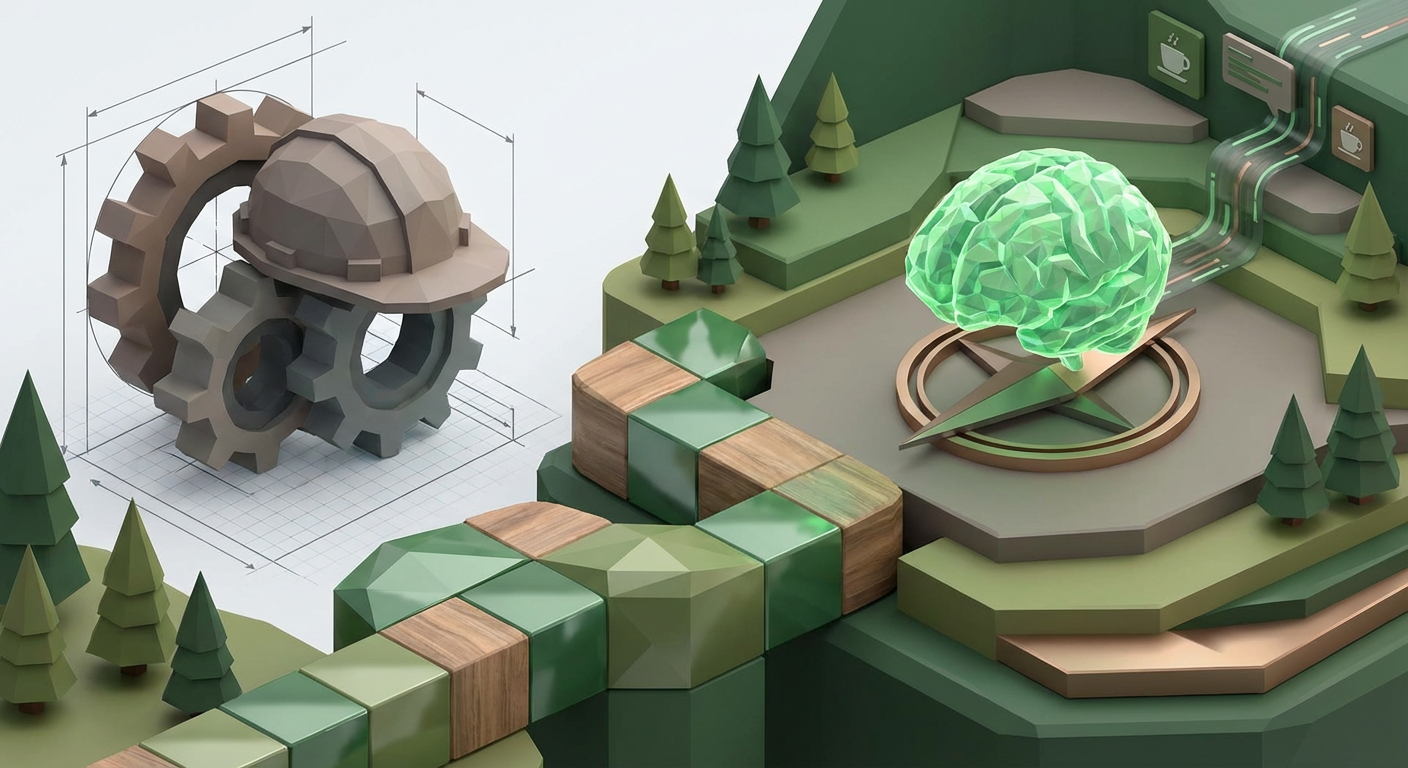
You can ship a working app in a day now. You can define the database, generate the frontend, and deploy it to the world before your morning coffee gets cold. But here is the uncomfortable truth lurking behind that speed: you can do all of that and still have no idea if anyone actually wants it.
That is the quiet shift a lot of builders are feeling right now. The hardest part of making software used to be engineering. You had to worry about server provisioning, boilerplate code, and syntax errors. Now, the bottleneck has moved. It’s not because we got lazier, but because the tools got sharper. The new constraint isn't code; it is validation. Generative AI fundamentally removes the natural constraint that expensive engineers imposed on software development, redefining where discipline must come from as building becomes cheaper.
In a recent conversation with another builder, one line landed with unusual clarity: "What used to be the hard part is now easy. And now what used to be the thing that was not a lot of time pressure... this is the slow part." That "slow part" is proving the hypothesis beneath the product before you sink time into polishing something the market will ignore. This shift means that the value now lies before and after the model, emphasizing the importance of foundational understanding and evaluation rather than just model building.
The New Reality: Shipping Is Cheap, Attention Is Expensive
For years, the default startup story followed a predictably linear path: come up with an idea, spend months building it, launch it, and then worry about marketing. That sequence is fundamentally breaking down.
Today, teams can build the first version shockingly quickly. We are seeing a "product factory" mentality where you can go from an idea to a deployed production app in two hours. The trajectory is real. It used to take two months, then two weeks, and now we are measuring development cycles in hours. This rapid development has even led to the emergence of roles like the "Product Maker," who spends most of their time understanding needs, exploring design, and "vibe coding" user-facing features almost entirely within the AI sphere with non-CS skills dominating.
But this creates a basic economic problem. If you can create supply-software-at near-zero marginal cost, the scarce resource shifts. The scarcity is now demand: attention, trust, distribution, and timing. As the market floods with products, the noise level rises. "Building faster" stops being a competitive advantage once everyone can do it.
The winners in this new era aren't the ones who ship the most features. They are the ones who:
- Validate faster than they build
- Understand distribution before writing a line of code
- Avoid technical dead-ends and platform lock-in
- Can iterate without paying a massive "tax" for growth
The Hidden Cost of "Build Fast" Platforms
To move fast, many developers turn to "vibe coding" environments and all-in-one build platforms. These tools are undeniably powerful. They compress time and lower the skill barrier. But fast starts often hide expensive exits.
There is a pattern in systems design where "easy to start" often means "hard to leave." Platforms that abstract away all the complexity often couple your product to their proprietary ecosystem. One telling friction point we see is the "code vs. system" gap. You might be able to export your code to GitHub, but the operational structure-the databases, the authentication flows, the edge functions-remains stuck in the platform that generated it.
The "Platform Tax" Shows Up When You Succeed
The riskiest moment isn't when you are experimenting; it is when you are growing. That is when the platform tax hits. It usually looks like this:
- Seat-based licensing that skyrockets as you add users
- API usage fees that punish you for high-volume workflows
- Hard limits that push you into enterprise tiers prematurely
- Architectural constraints that prevent performance optimization
Migration isn't just a copy-paste job. It is reconstituting an entire runtime system. This is why, at FlowDevs, we emphasize building on scalable cloud infrastructure and standard, commodity components from day one. It buys you freedom. You get bargaining power on pricing, easier compliance decisions, and less fear of a tool changing its terms of service midstream.
Why Validation Is Slower Than Building
If AI tools can generate code in seconds, why can't they generate commercial certainty? Because validation depends on human systems, not technical ones. Getting a "yes" from a machine is easy; getting a "yes" from a human with a wallet is hard.
When building was expensive, you validated because you had to-you couldn't afford to waste six months on a dud. When building is cheap, the temptation is to skip validation because you can. You end up with a graveyard of clean demos and no customers.
Real validation requires signals that are harder to fake than a clickable prototype:
- A reachable audience that trusts you
- Feedback that is honest, not polite
- Evidence of willingness to pay, not just willingness to sign up
As one builder put it: "If you can't build the demand, then don't build the thing." This aligns with the understanding that while AI can democratize model building, the crucial aspect for data science and product development shifts from merely creating to ensuring models are built on the right foundations and address real needs.
Building a "Product Factory" Without the Fragility
So, how do you compete in a world where everyone can ship? You don't slow down, but you do change where you focus your attention.
The goal is to treat validation with the same discipline you treat your build pipeline. It means establishing a "product factory" mindset where you can spin up experiments on stable, scalable infrastructure without reinventing the wheel every time. In the past, companies competed on software quality, professional services, or financial resources. With AI, a new divergence in product development philosophies is emerging, highlighting the need for unique approaches whether you are a startup or a large enterprise to appeal to core users.
1. Validate at the Speed You Build
If you can build a feature in a day, you need to be able to test it in a day. Design tests with clear pass/fail signals. Do users come back without reminders? Did they try to use the feature before you even announced it? The goal isn't just "feedback"-it is reducing uncertainty.
2. Beware of Client-Side Blind Spots
A technical nuance often missed in the "no-code" rush is how applications render. Many instant-app tools default to client-side rendering (CSR). This is fine for internal tools, but if you need SEO and discoverability, it can be a death sentence. Crawlers often struggle to execute the JavaScript needed to "see" your content. If you are building for the public web, ensure your architecture supports server-side rendering or static generation.
3. Own Your Infrastructure
Move fast, but keep ownership. Whether we are building custom web applications or deploying Power Platform solutions, the principle remains: use interchangeable components. Rely on relational databases and standard APIs rather than proprietary glue that traps you. This approach costs a little more effort upfront than a "magic" builder, but it ensures that your business creates equity in its own systems, not someone else's platform.
The Work Didn't Disappear-It Just Moved Upstream
AI didn't kill software development. It demoted the act of typing code and promoted the act of strategic thinking. The difficult part now isn't implementation; it is earning the right to implement by finding real demand. As building becomes easier, the question shifts from "can we build it?" to "should we build it?" underscoring the importance of strategic and agile principles.
At FlowDevs, we help businesses navigate this shift. Whether it is streamlining complex workflows with Power Automate or building custom software that avoids the platform trap, we partner with you to ensure you aren't just building fast-you are building correctly.
If you are ready to move from "can we build it" to "should we build it," let's talk. You can find a time that works for you on our bookings page.
You can ship a working app in a day now. You can define the database, generate the frontend, and deploy it to the world before your morning coffee gets cold. But here is the uncomfortable truth lurking behind that speed: you can do all of that and still have no idea if anyone actually wants it.
That is the quiet shift a lot of builders are feeling right now. The hardest part of making software used to be engineering. You had to worry about server provisioning, boilerplate code, and syntax errors. Now, the bottleneck has moved. It’s not because we got lazier, but because the tools got sharper. The new constraint isn't code; it is validation. Generative AI fundamentally removes the natural constraint that expensive engineers imposed on software development, redefining where discipline must come from as building becomes cheaper.
In a recent conversation with another builder, one line landed with unusual clarity: "What used to be the hard part is now easy. And now what used to be the thing that was not a lot of time pressure... this is the slow part." That "slow part" is proving the hypothesis beneath the product before you sink time into polishing something the market will ignore. This shift means that the value now lies before and after the model, emphasizing the importance of foundational understanding and evaluation rather than just model building.
The New Reality: Shipping Is Cheap, Attention Is Expensive
For years, the default startup story followed a predictably linear path: come up with an idea, spend months building it, launch it, and then worry about marketing. That sequence is fundamentally breaking down.
Today, teams can build the first version shockingly quickly. We are seeing a "product factory" mentality where you can go from an idea to a deployed production app in two hours. The trajectory is real. It used to take two months, then two weeks, and now we are measuring development cycles in hours. This rapid development has even led to the emergence of roles like the "Product Maker," who spends most of their time understanding needs, exploring design, and "vibe coding" user-facing features almost entirely within the AI sphere with non-CS skills dominating.
But this creates a basic economic problem. If you can create supply-software-at near-zero marginal cost, the scarce resource shifts. The scarcity is now demand: attention, trust, distribution, and timing. As the market floods with products, the noise level rises. "Building faster" stops being a competitive advantage once everyone can do it.
The winners in this new era aren't the ones who ship the most features. They are the ones who:
- Validate faster than they build
- Understand distribution before writing a line of code
- Avoid technical dead-ends and platform lock-in
- Can iterate without paying a massive "tax" for growth
The Hidden Cost of "Build Fast" Platforms
To move fast, many developers turn to "vibe coding" environments and all-in-one build platforms. These tools are undeniably powerful. They compress time and lower the skill barrier. But fast starts often hide expensive exits.
There is a pattern in systems design where "easy to start" often means "hard to leave." Platforms that abstract away all the complexity often couple your product to their proprietary ecosystem. One telling friction point we see is the "code vs. system" gap. You might be able to export your code to GitHub, but the operational structure-the databases, the authentication flows, the edge functions-remains stuck in the platform that generated it.
The "Platform Tax" Shows Up When You Succeed
The riskiest moment isn't when you are experimenting; it is when you are growing. That is when the platform tax hits. It usually looks like this:
- Seat-based licensing that skyrockets as you add users
- API usage fees that punish you for high-volume workflows
- Hard limits that push you into enterprise tiers prematurely
- Architectural constraints that prevent performance optimization
Migration isn't just a copy-paste job. It is reconstituting an entire runtime system. This is why, at FlowDevs, we emphasize building on scalable cloud infrastructure and standard, commodity components from day one. It buys you freedom. You get bargaining power on pricing, easier compliance decisions, and less fear of a tool changing its terms of service midstream.
Why Validation Is Slower Than Building
If AI tools can generate code in seconds, why can't they generate commercial certainty? Because validation depends on human systems, not technical ones. Getting a "yes" from a machine is easy; getting a "yes" from a human with a wallet is hard.
When building was expensive, you validated because you had to-you couldn't afford to waste six months on a dud. When building is cheap, the temptation is to skip validation because you can. You end up with a graveyard of clean demos and no customers.
Real validation requires signals that are harder to fake than a clickable prototype:
- A reachable audience that trusts you
- Feedback that is honest, not polite
- Evidence of willingness to pay, not just willingness to sign up
As one builder put it: "If you can't build the demand, then don't build the thing." This aligns with the understanding that while AI can democratize model building, the crucial aspect for data science and product development shifts from merely creating to ensuring models are built on the right foundations and address real needs.
Building a "Product Factory" Without the Fragility
So, how do you compete in a world where everyone can ship? You don't slow down, but you do change where you focus your attention.
The goal is to treat validation with the same discipline you treat your build pipeline. It means establishing a "product factory" mindset where you can spin up experiments on stable, scalable infrastructure without reinventing the wheel every time. In the past, companies competed on software quality, professional services, or financial resources. With AI, a new divergence in product development philosophies is emerging, highlighting the need for unique approaches whether you are a startup or a large enterprise to appeal to core users.
1. Validate at the Speed You Build
If you can build a feature in a day, you need to be able to test it in a day. Design tests with clear pass/fail signals. Do users come back without reminders? Did they try to use the feature before you even announced it? The goal isn't just "feedback"-it is reducing uncertainty.
2. Beware of Client-Side Blind Spots
A technical nuance often missed in the "no-code" rush is how applications render. Many instant-app tools default to client-side rendering (CSR). This is fine for internal tools, but if you need SEO and discoverability, it can be a death sentence. Crawlers often struggle to execute the JavaScript needed to "see" your content. If you are building for the public web, ensure your architecture supports server-side rendering or static generation.
3. Own Your Infrastructure
Move fast, but keep ownership. Whether we are building custom web applications or deploying Power Platform solutions, the principle remains: use interchangeable components. Rely on relational databases and standard APIs rather than proprietary glue that traps you. This approach costs a little more effort upfront than a "magic" builder, but it ensures that your business creates equity in its own systems, not someone else's platform.
The Work Didn't Disappear-It Just Moved Upstream
AI didn't kill software development. It demoted the act of typing code and promoted the act of strategic thinking. The difficult part now isn't implementation; it is earning the right to implement by finding real demand. As building becomes easier, the question shifts from "can we build it?" to "should we build it?" underscoring the importance of strategic and agile principles.
At FlowDevs, we help businesses navigate this shift. Whether it is streamlining complex workflows with Power Automate or building custom software that avoids the platform trap, we partner with you to ensure you aren't just building fast-you are building correctly.
If you are ready to move from "can we build it" to "should we build it," let's talk. You can find a time that works for you on our bookings page.
Related Blog Posts
Lovable Day 2026: Valentines Day to the 50% Off Promotion
The Art of Inquiry: Finding Better Answers by Asking Better Questions