Does the world of AI feel like a whirlwind of terminology to you? A thousand concepts are flying around at once. Everyone is talking about agents, RAG, embeddings, and guardrails, and yet, there is rarely a clear explanation of how these pieces actually fit together.
To really leverage these technologies, we need to put structure to the chaos. What if we could organize AI the way chemistry organizes matter? Imagine arranging these concepts into families, rows, predictable combinations, and "reactions" that you can recognize instantly.
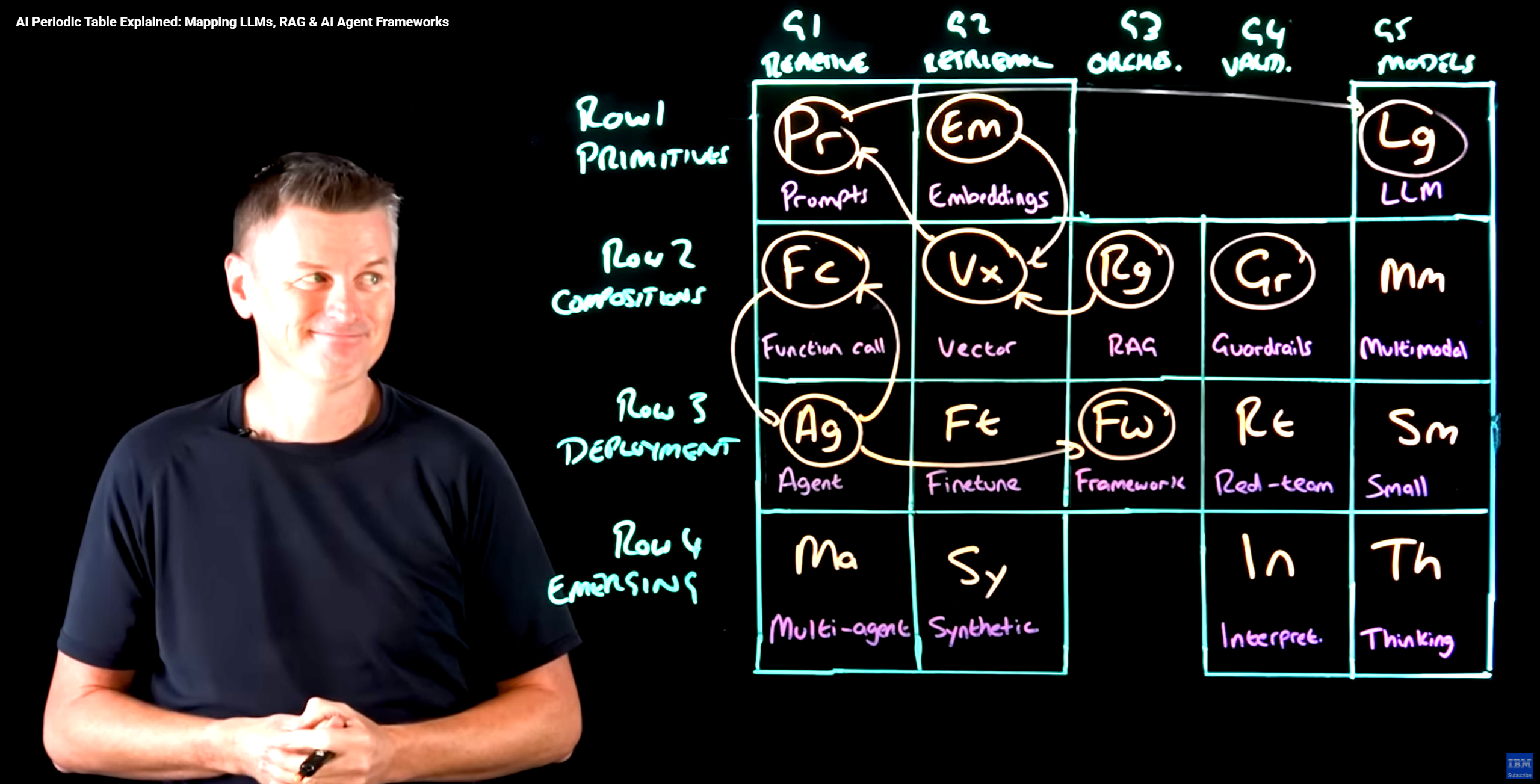
Welcome to the AI periodic table. While there is no official scientific table for artificial intelligence, this framework allows you to walk into any architecture diagram, product demo, or strategy session and decode exactly what is happening. You will see which elements are being used, how they connect, and critically, what might be missing.
The Layout: Rows and Families
To build this table, we organize AI concepts along two specific axes:
- Rows (Periods): Increasing system complexity, moving from basic atoms to complex systems.
- Columns (Groups/Families): Concepts that behave similarly and build upon one another.
We categorize these into five distinct families:
- G1 Reactive (Action/Control): Systems that do things.
- G2 Retrieval (Memory/Search): Systems that remember and find information.
- G3 Orchestration (Coordination): The plumbing that connects the pieces.
- G4 Validation (Safety/Quality): The controls that keep the system reliable.
- G5 Models (Core Capability): The intelligence engines themselves.
Row 1: Primitives (The Atoms)
This row contains the atomic building blocks. Without these, modern AI applications do not exist.
Pr - Prompting (Reactive)
Also known as the instruction you give an AI. Whether it is "summarize this email" or "write code for a React component," prompts are reactive. Change a single word, and you get a wildly different result.
Em - Embeddings (Retrieval)
Embeddings are numeric representations of meaning. When we take text and convert it into a vector (a list of numbers), we capture its semantic intent. This allows computers to understand that "feline" and "cat" are related, forming the basis of AI memory.
Lg - Large Language Model (Models)
The foundation itself. Whether it is ChatGPT, Claude, or an open-source model, these are the "noble gases" of our table. They are the stable, foundational capabilities that everything else reacts around.
Row 2: Compositions (The Molecules)
Row 2 is where AI becomes useful for business. At FlowDevs, this is often where we start building repeatable, valuable workflows.
Fc - Function Calling (Reactive)
This occurs when an LLM invokes a tool before answering. Instead of guessing the weather, the model calls an API and responds with live data. This shifts the system from purely creative to functional.
Vx - Vector Databases (Retrieval)
If embeddings encode meaning, Vector DBs store that meaning at scale. This allows for fast recall of specific business data, effectively turning retrieval into infrastructure.
Rg - RAG (Orchestration)
Retrieval-Augmented Generation (RAG) is the pattern of connecting memory to the model. The system retrieves relevant context from your business data and inserts it into the prompt. This grounds the LLM in reality, reducing hallucinations.
Gr - Guardrails (Validation)
These are runtime safety controls. They validate outputs to ensure the AI doesn't leak secrets or produce nonsense. In enterprise environments like those we build for our clients, guardrails are not optional; they are essential.
Row 3: Deployment (Production Adaptation)
This row defines how AI survives in the real world. This is the domain of robust digital strategy.
Ag - Agents (Reactive)
Agents utilize a loop: think, act, observe. Instead of a single response, the system iterates toward a goal. This is the evolution from simple control to autonomy.
Ft - Fine-Tuning (Retrieval)
Fine-tuning bakes specific knowledge into the model's weights. It serves as a deeper, more permanent form of memory compared to vector databases.
Fw - Frameworks (Orchestration)
Frameworks act as the plumbing and scaffolding across the system. This includes tools like LangChain or Microsoft Copilot Studio, which we use to coordinate complex workflows and integrations.
Rt - Red Teaming (Validation)
If guardrails are the seatbelt, red teaming is the crash test. This involves adversarial testing into prompt injection and data exfiltration to ensure the system is secure before deployment.
Row 4: Emerging (Frontier Patterns)
The landscape changes fast. This row represents patterns that are currently rapidly evolving, such as Multi-Agent Systems (Ma) where distributed autonomous agents collaborate, and Thinking Models (Th) that allocate more compute time to "reason" before answering.
Predicting Reactions: How It Fits Together
The value of a periodic table isn't just memorization; it is predicting how elements combine. Here are two standard "reactions" we implement regularly.
Reaction 1: The Corporate Knowledge Base (Production RAG)
This is the standard pattern for a chatbot that knows your company documentation. It combines:
- Em (Embeddings) to encode documents.
- Vx (Vector DB) to store them.
- Rg (RAG) to retrieve chunks.
- Lg (LLM) to generate the answer.
- Gr (Guardrails) to ensure compliance.
Reaction 2: The Agentic Loop
This pattern is for achieving goals, such as "Book a meeting for next Tuesday."
- Ag (Agent) breaks the goal into steps.
- Fc (Function Calling) interacts with your calendar API.
- Fw (Framework) handles the workflow logic and error handling.
Applying This to Your Business
Next time you are evaluating a tool or planning a digital transformation strategy, try mapping usage to this table. Are you missing a validation element? are you over-engineering orchestration?
At FlowDevs, we specialize in understanding the chemistry of these systems. Whether it is building scalable cloud infrastructure or deploying intelligent agents via Power Platform and Copilot Studio, we ensure the right elements are combined to drive efficiency.
If you are ready to stop guessing and start building intelligent, structured solutions, reach out to us. Let's find the right reaction for your business context.
Video Source from IBM: AI Periodic Table Explained: Mapping LLMs, RAG & AI Agent Frameworks
Does the world of AI feel like a whirlwind of terminology to you? A thousand concepts are flying around at once. Everyone is talking about agents, RAG, embeddings, and guardrails, and yet, there is rarely a clear explanation of how these pieces actually fit together.
To really leverage these technologies, we need to put structure to the chaos. What if we could organize AI the way chemistry organizes matter? Imagine arranging these concepts into families, rows, predictable combinations, and "reactions" that you can recognize instantly.
Welcome to the AI periodic table. While there is no official scientific table for artificial intelligence, this framework allows you to walk into any architecture diagram, product demo, or strategy session and decode exactly what is happening. You will see which elements are being used, how they connect, and critically, what might be missing.
The Layout: Rows and Families
To build this table, we organize AI concepts along two specific axes:
- Rows (Periods): Increasing system complexity, moving from basic atoms to complex systems.
- Columns (Groups/Families): Concepts that behave similarly and build upon one another.
We categorize these into five distinct families:
- G1 Reactive (Action/Control): Systems that do things.
- G2 Retrieval (Memory/Search): Systems that remember and find information.
- G3 Orchestration (Coordination): The plumbing that connects the pieces.
- G4 Validation (Safety/Quality): The controls that keep the system reliable.
- G5 Models (Core Capability): The intelligence engines themselves.
Row 1: Primitives (The Atoms)
This row contains the atomic building blocks. Without these, modern AI applications do not exist.
Pr - Prompting (Reactive)
Also known as the instruction you give an AI. Whether it is "summarize this email" or "write code for a React component," prompts are reactive. Change a single word, and you get a wildly different result.
Em - Embeddings (Retrieval)
Embeddings are numeric representations of meaning. When we take text and convert it into a vector (a list of numbers), we capture its semantic intent. This allows computers to understand that "feline" and "cat" are related, forming the basis of AI memory.
Lg - Large Language Model (Models)
The foundation itself. Whether it is ChatGPT, Claude, or an open-source model, these are the "noble gases" of our table. They are the stable, foundational capabilities that everything else reacts around.
Row 2: Compositions (The Molecules)
Row 2 is where AI becomes useful for business. At FlowDevs, this is often where we start building repeatable, valuable workflows.
Fc - Function Calling (Reactive)
This occurs when an LLM invokes a tool before answering. Instead of guessing the weather, the model calls an API and responds with live data. This shifts the system from purely creative to functional.
Vx - Vector Databases (Retrieval)
If embeddings encode meaning, Vector DBs store that meaning at scale. This allows for fast recall of specific business data, effectively turning retrieval into infrastructure.
Rg - RAG (Orchestration)
Retrieval-Augmented Generation (RAG) is the pattern of connecting memory to the model. The system retrieves relevant context from your business data and inserts it into the prompt. This grounds the LLM in reality, reducing hallucinations.
Gr - Guardrails (Validation)
These are runtime safety controls. They validate outputs to ensure the AI doesn't leak secrets or produce nonsense. In enterprise environments like those we build for our clients, guardrails are not optional; they are essential.
Row 3: Deployment (Production Adaptation)
This row defines how AI survives in the real world. This is the domain of robust digital strategy.
Ag - Agents (Reactive)
Agents utilize a loop: think, act, observe. Instead of a single response, the system iterates toward a goal. This is the evolution from simple control to autonomy.
Ft - Fine-Tuning (Retrieval)
Fine-tuning bakes specific knowledge into the model's weights. It serves as a deeper, more permanent form of memory compared to vector databases.
Fw - Frameworks (Orchestration)
Frameworks act as the plumbing and scaffolding across the system. This includes tools like LangChain or Microsoft Copilot Studio, which we use to coordinate complex workflows and integrations.
Rt - Red Teaming (Validation)
If guardrails are the seatbelt, red teaming is the crash test. This involves adversarial testing into prompt injection and data exfiltration to ensure the system is secure before deployment.
Row 4: Emerging (Frontier Patterns)
The landscape changes fast. This row represents patterns that are currently rapidly evolving, such as Multi-Agent Systems (Ma) where distributed autonomous agents collaborate, and Thinking Models (Th) that allocate more compute time to "reason" before answering.
Predicting Reactions: How It Fits Together
The value of a periodic table isn't just memorization; it is predicting how elements combine. Here are two standard "reactions" we implement regularly.
Reaction 1: The Corporate Knowledge Base (Production RAG)
This is the standard pattern for a chatbot that knows your company documentation. It combines:
- Em (Embeddings) to encode documents.
- Vx (Vector DB) to store them.
- Rg (RAG) to retrieve chunks.
- Lg (LLM) to generate the answer.
- Gr (Guardrails) to ensure compliance.
Reaction 2: The Agentic Loop
This pattern is for achieving goals, such as "Book a meeting for next Tuesday."
- Ag (Agent) breaks the goal into steps.
- Fc (Function Calling) interacts with your calendar API.
- Fw (Framework) handles the workflow logic and error handling.
Applying This to Your Business
Next time you are evaluating a tool or planning a digital transformation strategy, try mapping usage to this table. Are you missing a validation element? are you over-engineering orchestration?
At FlowDevs, we specialize in understanding the chemistry of these systems. Whether it is building scalable cloud infrastructure or deploying intelligent agents via Power Platform and Copilot Studio, we ensure the right elements are combined to drive efficiency.
If you are ready to stop guessing and start building intelligent, structured solutions, reach out to us. Let's find the right reaction for your business context.
Video Source from IBM: AI Periodic Table Explained: Mapping LLMs, RAG & AI Agent Frameworks